
When Ouddhena Eronigca Teern first came to Estonia, the first thing she noticed was the volume. Or rather, the lack of it. After years of living in the lively, high-decibel worlds of Kuala Lumpur, Singapore and Dubai, the silence was striking.
“I don’t know if I would call it love at first sight,” she says, recalling her first impressions of Estonia. “But it was quiet at first sight. First audible sight.”
From the Tropics to Potatoes
Ouddhena’s own background is layered too: Malaysian Kannada-Tamil, Kristang Portuguese-Malay and Arab heritage. “Growing up in multicultural Malaysia shaped my understanding of identity as something fluid, layered, and deeply interconnected,” she explains.
Her first connection to Estonia began in Dubai, where she was living at the time. One late night, she went to the gym for exactly one reason: to be alone.
“I just wanted my alone time after working with people all week long,” she recalls. “Then this one dude walked in. I could see from the reflection of the mirror that he wanted to talk, but I was not in the mood.”
They exchanged pleasantries, and Ouddhena left early — her solo evening abruptly disrupted.
Life, however, had a sense of humour. Some time later, Ouddhena and the stranger crossed paths again and discovered that they were not only living in the same apartment building, but also working for the same company. One conversation led to another, and eventually, the topic of his home country came up.
“I had no idea where Estonia was,” Ouddhena admits. “I quickly Googled: where is Estonia? I’ve heard of Lithuania, I’ve heard of Latvia, never Estonia.”
The map showed her “a very tiny spot in between Finland and the rest”.
“Then I Googled the next natural thing for a Malaysian to do, which is: what’s the national food?” she laughs. “Something came up that looked like a pineapple and I had never imagined the Queen of Tropical Fruits would make an appearance so far north in Europe. So I asked him: is that a pineapple? And he stoically said no, that’s not pineapple, those are potatoes.”
That “one dude” from the gym is now her husband and the father of her son.
“So I started slowly taking an interest in Estonia because I was in love with an Estonian man,” she says. “And that’s how I got to know Estonia.”
After several visits, Ouddhena moved to Estonia on the 28th of December 2019 — just before the world changed with the arrival of the pandemic.
Learning Estonian, bravely and imperfectly
For Ouddhena, integration has never meant becoming perfectly Estonian. What has helped most is meeting the process with humour — and being able to laugh at herself when the Estonian words do not come out quite right.
She still remembers walking into Selver for the first time and confidently calling it “Silver” by a fluke of phonetics.
“I felt completely disoriented by word jumbles that I could not yet understand,” she says. “The first two words I learned were ‘kana’ and ‘muna’, made easy because they rhyme. Later came ‘magus maasikas’, which I picked up from a cardboard display at Nõmme Turg, much to the amusement of the stall keeper because of my questionable accent.”
The funny beginnings, however, grew into something much more serious. Ouddhena started with an A1 course through Settle in Estonia, later continued to B1 and has now progressed to B2 level.
“My goal is to reach C1 level and to eventually speak the Estonian language confidently in professional and public settings, without my brain suddenly buffering like the slow internet of the 90’s era,” she says.
For her, this is not only about fluency. “Learning Estonian has been central to my integration journey,” she says. “From the very beginning, I understood that language is not just a communication tool. It is a key to belonging.”
“Updating” her cultural systems
Language was not the only thing Ouddhena had to learn. Coming from more collective societies, she also had to get used to a different understanding of personal space, boundaries and when to intervene.
One moment on a public bus stayed with her.
“I once saw a child get slightly caught in a bus door situation, and the entire bus collectively observed, and continued existing without lifting a finger to help. I ended up calling out to the driver, in broken Estonian ‘palun uks taga lahti, väike laps on veel siin’. He immediately opened the door. Crisis resolved.”
For Ouddhena, the moment was not a reason to judge Estonia, but to understand it.
“It was a moment that stayed with me, not as criticism but as cultural contrast,” she explains. “I have since come to understand that in Estonia, support often exists, but it is activated on request, not assumption.”
Art as a bridge and a mirror
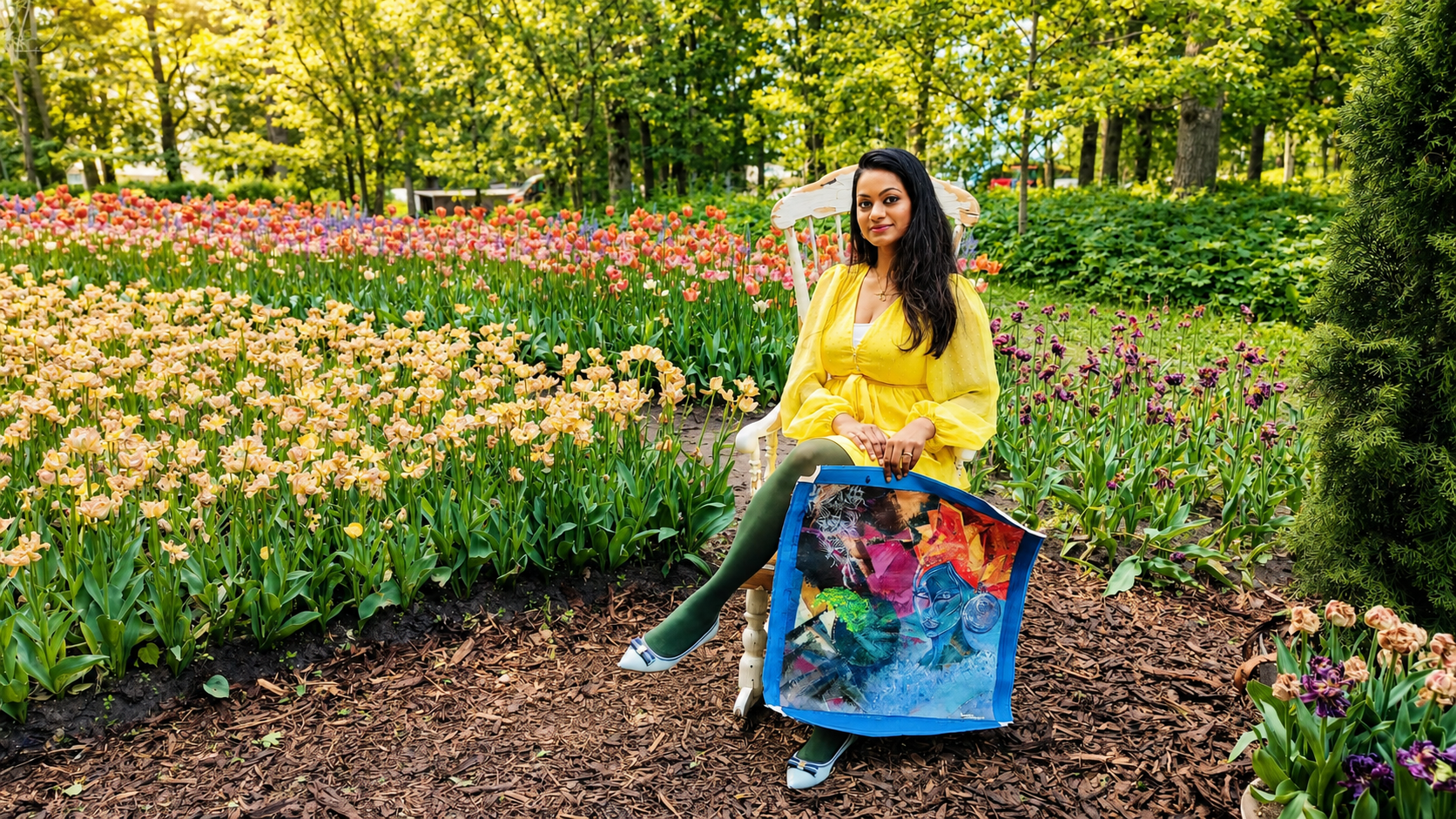
Today, Ouddhena’s work in Estonia brings together art, culture, society and soft diplomacy. She is the founder and creative director of Batiksuutra, a community-based social enterprise that supports mental and emotional well-being through a holistic, arts-based approach.
“I collaborate with local museums, and cultural institutions, developing art-projects that gently bring social themes into public awareness through creativity and artistic expression,” she explains.
Estonia has also changed the way she practices her own artistry. Earlier in her career, she had exhibited internationally, but her work was often connected to fantasy, escapism and building a portfolio. In Estonia, something changed.
“Two years ago when I turned 40 years old – call it mid-life crisis or mid-life renaissance – either way, I realized something shifted inside of me and I wanted to do something with the community to show my appreciation for Estonia,” she says.
That shift eventually led her to a nationwide project about migrant women’s lived experiences in Estonia, called, ‘’All Roads Led to Eestimaa-Portals of Inbetweenness’’ that is currently on display at the People’s Museum of Tallinn.
“I realized there are a lot of social issues that are not being spoken about,” she says. “Because I am a controversial writer and controversial artist by nature, I took it as a challenge to address these issues.”
For Ouddhena, the exhibition is not about pointing fingers. It is about creating a mirror.
“I’m trying to be the middle person, like a mirror to Estonian society and also to non-Estonians living in Estonia,” she says. “For Estonians, it is a chance to see the challenges migrant women face, how they overcome them, and why they continue to build their lives here. For migrant women, it is a form of motivation to rebuild their lives in a new land, an encouragement to learn the language and to take part in society.”
The quiet work of healing
Alongside her artistry, Ouddhena also works as a trauma-informed counsellor for people with a migrant background in Estonia. For her, it is “soul work”.
“They look like any ordinary person like you and me,” she says. “Could be somebody waiting at the bus stop, could be somebody that you bump into on the street. On the outside, they look like any normal person, but the depth of the pain that they’re going through or carrying is too much.”
Many of the people she supports have been directly affected by war or by displacement driven by diverse migratory pressures, leaving them with a diminished sense of identity and belonging. Others carry what she describes as the secondary effects of war — experiences inherited from being born into conflict or growing up in its aftermath, sometimes so deeply buried that large parts of their lives remain difficult to remember, albeit the body remembers when the mind seemingly forgets.
For Ouddhena, art and counselling are part of the same larger mission: building a healthy community, making shared pain visible, and helping people feel less alone.
Here to stay
Ouddhena has no doubt about where she wants to build her life.
“My future is here in Eestimaa,” she says.
She aims to continue working in contemporary art, cultural diplomacy, and trauma-informed counselling, while amplifying Estonia’s creative voice internationally and offering a listening ear to vulnerable and marginalised members of society here.
“There is so much of Estonia’s artistic and cultural richness that remains unseen beyond its borders, often due to language and visibility barriers,” she says. “My goal is to contribute to changing that narrative by helping to share Estonia’s creative identity on a global stage.”
She also hopes to keep building cross-cultural projects that honour both where she comes from and where she lives now.
“As someone who exists between cultures, I feel a sense of responsibility and an opportunity to bridge perspectives between Estonia and the wider world.”
And Estonia, in her view, does have warmth. It simply reveals itself slowly like the nordic sun that likes to play hide and seek.
“From my experience, Estonia is a deeply honest country and once you understand its rhythm, it starts to embrace you.”
Ouddhena’s tips for finding your rhythm in Estonia
- Don’t rush your judgment. “Estonia is not a ‘speedy relationship’ country. It’s slow and patient but might be worth the wait. Relationships here take time to build but when trust is formed, it is often deep and lasting.”
- Learn the language — even imperfectly. “Even imperfect Estonian opens doors that otherwise remain closed. Pay attention to the small social nuances, the silence, and the unspoken rules. They all carry meaning.”
- Look past first impressions. “Take time to understand Estonia through its culture and history, not just through first impressions.”
- Decode the silence. “Do not assume silence means disinterest. Sometimes it just means deep thinking, or energy-saving for existing efficiently in a cold climate.”
- Find the humour. “There is humour in Estonia too. It just arrives dry and dark depending on the season.”
The Settle in Estonia Programme is a free educational programme provided by the Estonian state which is intended to help the foreigners who have arrived in Estonia to adapt and become accustomed to local life more easily. We offer courses for people who have come to live or study in Estonia and have lived here for less than 5 years. For example, war refugees to whom Estonia offers international or temporary protection, as well as people who have come to Estonia to work or do business here or relocate with their family member. The adaptation program The Settle in Estonia Programme is free for participants. We offer language training and other courses to help you cope with everyday life in Estonia. Read more and register: https://integratsioon.ee/en/kohanemine. The adaptation programme is co-funded by the European Union and the state budget.