
If you have ever searched online for “life in Estonia,” “moving to Estonia” or “Estonian culture,” chances are you have come across Manan Anwar. For years, his YouTube videos and articles have helped newcomers make sense of life in this small Baltic country. Behind that extensive archive of advice, however, is someone who arrived in Estonia knowing very little about what awaited him.
Originally from Pakistan, Manan’s journey to Estonia began in 2014. An engineer by profession, he was not looking for a fairytale or a lifelong home. He was simply looking for a Master’s degree.
“I was fortunate enough to get an Erasmus scholarship to Estonia. Coming here was not something I had planned; I did not know much about Estonia,” Manan explains. “I come across a lot of people who tell me they fell in love with Estonia and then came to live here. I wasn’t like that.”
A Fish Out of Water
The cultural leap from the vibrant hustle of Pakistan to the quiet reserve of Estonia was as wide as it gets. For Manan, the two environments felt “diametrically opposite”.
“Here you have so much silence and quietness. In Pakistan, everywhere you go you have noise, hustle and bustle, and crowds. I joke sometimes that I was like a fish out of water—and then I somehow learned to live without it,” he says.
The adjustment was a physical and emotional marathon. The legendary Estonian winters and the stoic nature of the locals proved to be his steepest hurdles. “Nobody warned me about how long and dark the winter was going to be. And people were so quiet, introverted and distant. It was a really big struggle, and I think I changed myself a lot in order to live here and adapt.”
What was meant to be a temporary academic stay soon blossomed into a career. Before he even reached his final semester, Manan landed a job in automotive electronics. He stayed with the company for several years, gradually absorbing the local way of life. “If there are any Estonian values that make somebody an Estonian, aside from appearance, I think all of those were just injected into me,” he laughs.
From Figuring It Out to Helping Others
In 2014, the "information vacuum" for foreigners in Estonia was real. Everyday logistics that locals took for granted were mysteries to newcomers. Manan spent his early years learning through trial and error, a process that sparked his desire to build a bridge for others.
“I was figuring things out on my own, and I thought it would be useful to share what I learned so that others wouldn’t have to go through the same process.”
This mission turned him into a prolific content creator. He began writing for major news portals and eventually built a YouTube channel that covers everything from the nuances of the Estonian language to the practicalities of winter gear. “I’m a stubborn guy,” he says with a smile. “I did it for a very long time. I covered almost everything that you need to know in Estonia.”
However, sharing his story wasn't just about being helpful—it was also a survival strategy. Moving from a massive social circle in Pakistan to starting from zero in Estonia had taken a toll on his mental health. “I started sharing my thoughts, ideas and feelings. I got a lot of pushback as well, but also a lot of acceptance. It made me feel that I wasn’t alone.”
Rewiring the Brain: The Language Journey
For Manan, the most profound step in his integration was learning the language. He views learning Estonian as more than just a communication tool; he sees it as a psychological transformation. He now advises anyone staying longer than a month to begin immediately.
“It’s not just about the language; it’s something about your neural programming,” he explains. “When you speak Estonian, you sort of start to think in an Estonian way and you start to understand a little bit more. I don’t know what sort of magic it is, but it does help.”
His breakthrough came through an Integration Foundation language course, where the emphasis was on total immersion. “The Integration Foundation course was the best because they fully immersed you. You weren’t allowed to talk in English. The first few times were really unnerving—I felt like the stupidest person there. I even wrote a really long email asking them to please take it slow and be easy on me. But eventually, I got used to the approach and it became a really good learning experience.”
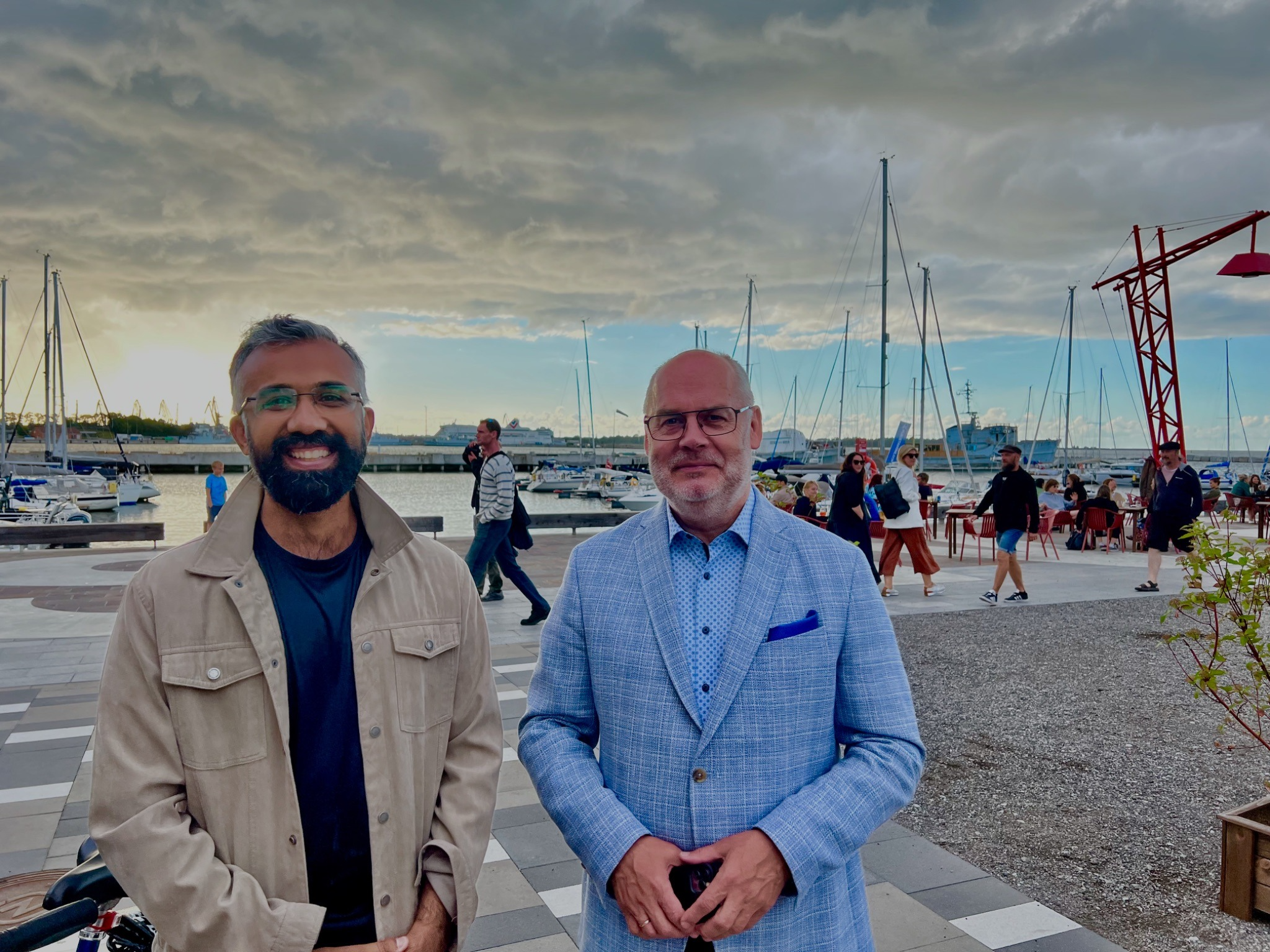
The program was led by Mall Pesti, co-author of one of Estonia’s most beloved language-learning books, E nagu Eesti. “I also got to meet her and that was truly a fan moment for me,” Manan says. The two also took a photo together to mark the occasion.
Earning the Blue-Black-and-White
In 2024, after a decade of building a life in Estonia, Manan officially became an Estonian citizen. The process required patience: years of residence and work, the B1 language exam, the citizenship test and, in his case, renouncing his Pakistani citizenship. For Manan, the fact that he had to fight for it made the result even more meaningful.
“The citizenship I was born with in Pakistan wasn’t something I had to earn—I simply had it by birth. But with Estonian citizenship, you really feel that you’ve earned it.”
For Manan, the B1 language exam was the most stressful part. When the notification of passing the exam finally arrived, it was a moment of pure joy. “I know so many people who have taken the test two, three or four times and keep missing it by one or two points. Thankfully, I passed on my first attempt. It was one of the happiest emails of my life.”
While he treasures his passport, he does have one wish for future new citizens: a sense of occasion. “You spend eight or nine years working towards something, and then you go to the Police and Border Guard Board, they hand you a packet across the desk, and that’s it,” he laughs. “I wish Estonia had a citizenship ceremony or an oath-taking ceremony. It would make the moment feel much more meaningful.”
Estonia Is Not for Everyone
Despite his deep attachment to his adopted home, Manan remains a realist. He warns that the country is a “niche product” and isn't a universal fit for every personality.
“Estonia is a very niche thing. It’s not for everybody. If you need a lot of stimulation, crowds, noise and hustle, then Estonia is probably not for you. You have to understand what your goals are. What do you want to achieve from being in Estonia, and what are the things you’re willing to give up for that? There is a price to moving anywhere.”
While the career ceiling can be hit quickly in a small country, Manan highlights the unparalleled quality of life for families. “If I had children, Estonia would be one of the few places where I would want to raise a family. It’s very well suited for that.”
Estonianized to the Core
Today, Manan jokes that he has become deeply ‘Estonianized’. He values his privacy, instinctively keeps his distance at bus stops, and has fully embraced the tradition of the sauna.
“Sauna is a completely opposite thing to what Estonia is. You sit in a dark, hot box together, naked with strangers, smushed together. It seemed so weird in the beginning, but now I really love sauna. It sort of balances the extreme of being an Estonian.”
He has noticed the same change in smaller everyday habits.
“Even before COVID, I remember looking at people waiting at bus stops and train stations, perfectly spaced apart. I’m sure you could take a ruler and measure it—and it would be two metres apart. But eventually, I was doing the same thing. It just felt perfectly normal.”
Perhaps that is the clearest sign of how much Estonia has become part of him. Recently, he was asked a question that made him reflect: over all these years, who has changed more—Estonia or him? His answer is not entirely clear-cut. Estonia has changed, but so has he. The habits that once felt unfamiliar now come naturally.
Right now, Manan does not have a grand plan for what the future holds. He has never been one for grand plans. He prefers to take things as they come. But whatever the next chapter may bring, Estonia will always remain part of his story.
“I’m an Estonian citizen; I’m attached to this country. Estonia will always be part of me, wherever life may take me,” he says.
The Settle in Estonia Programme is a free educational programme provided by the Estonian state which is intended to help the foreigners who have arrived in Estonia to adapt and become accustomed to local life more easily. We offer courses for people who have come to live or study in Estonia and have lived here for less than 5 years. For example, war refugees to whom Estonia offers international or temporary protection, as well as people who have come to Estonia to work or do business here or relocate with their family member. The adaptation program The Settle in Estonia Programme is free for participants. We offer language training and other courses to help you cope with everyday life in Estonia. Read more and register: https://integratsioon.ee/en/kohanemine. The adaptation programme is co-funded by the European Union and the state budget.