
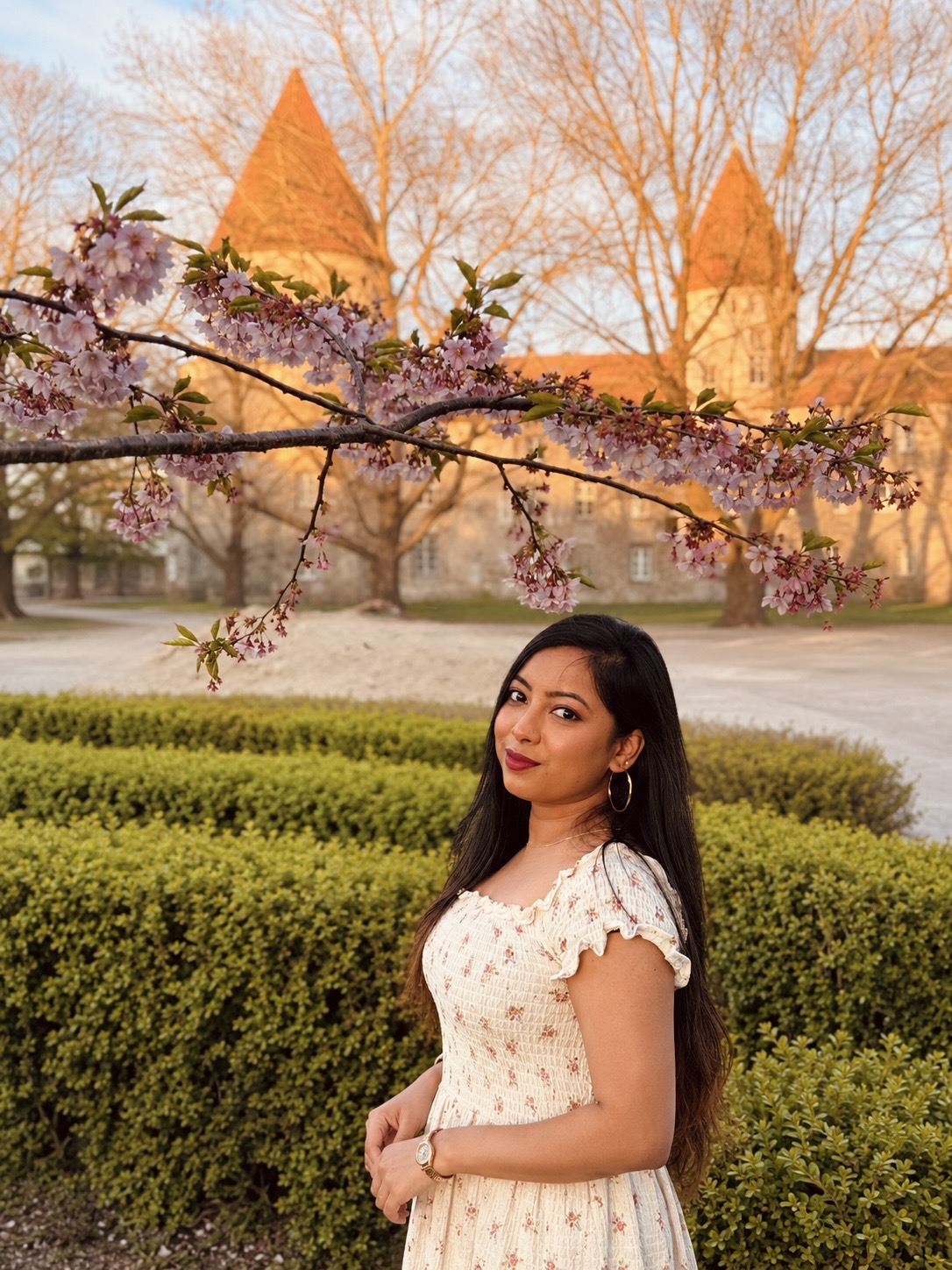
When Refat Noor Etu lands at Tallinn Airport after yet another trip abroad, she feels something settle inside her. The crowds disappear. The noise fades. Nobody stares. And in that familiar quiet, she catches herself thinking the same thing again and again: this is home.
For Noor, who moved to Estonia from Bangladesh in 2021, that feeling did not arrive all at once. It grew slowly—through snowy mornings, Estonian language classes, sauna sessions that felt like a test of survival, road trips across the country, and countless small everyday moments.
Today, Noor is almost on a mission to see every corner of Estonia. Whether she is standing on the shores of Sillamäe, wandering through the historic streets of Rakvere, or hiking in a bog at sunrise, she has made a habit of uncovering everything the country has to offer—and “hyping” a place she believes is still very underrated.
A Master’s Degree and a Long Honeymoon
Noor’s journey to Estonia began not with a dream of moving north, but with a search for a specific degree. With a background in economics, she was looking for a bridge into data science.
“I found that the University of Tartu actually offers a subject there,” she recalls. “I researched Estonia, and the more I saw, the more I really liked everything.”
The pandemic delayed her plans by a year, but it did not change them. Noor knew she wanted to be physically present for her studies, not follow them from afar. When she finally arrived in 2021 to begin her Master’s, Tartu quickly became her first home away from home. “I also love Tallinn where I live now, but Tartu is something else. It has a special place in my heart,” she says warmly.
Noor came to the University of Tartu on a full tuition waiver scholarship and she is still featured on the university’s Quantitative Economics programme page—a small moment she is still proud of.
She lived in a dorm on Narva maantee, studied at the university, took her first Estonian language classes in the university’s grand old main building, and discovered the kind of student life that makes Tartu feel welcoming even to someone arriving from the other side of the world. She remembers the legendary ease of meeting people at Möku bar and the encouragement she received when trying out even the smallest Estonian words.
Estonia also became the beginning of a new chapter in her personal life. Once Noor knew she was set to begin her studies in Tartu, she encouraged her partner to apply for a Master’s programme as well. He was accepted, and the couple—who had been together since their university days in Bangladesh—married just 15 days before relocating to Estonia to start their studies side by side.
Moving here essentially became their honeymoon. “I actually tell this to everyone—this is my honeymoon, and my honeymoon phase is still going, because I haven’t gotten tired of Estonia,” Noor laughs.
The Luxury of Safety and Personal Space
Coming from a densely populated tropical country, Noor expected Estonia to be different. What surprised her most, however, was not only the climate or the quiet streets. It was the sense of safety.
“Estonia is very safe, especially for women,” Noor explains. “In my home country, I would never go out at night alone. Here, it is completely fine. When you aren’t constantly concerned about your safety, you have the mental space and time to do other things. You aren't occupied by that fear.”
For Noor, safety is not an abstract value. It changes how a person moves through the world. It gives room to be curious, to explore, to take a walk at night, to build a life without constantly calculating risks in the background.
It has also made her more aware of the everyday privileges many locals may no longer notice: reliable public transport, personal space, quietness, and the possibility of living a decent life without having to fight for every basic comfort.
“Public transport here is like a dream. It is clean, it is always on time, and people respect your privacy. They don’t even sit right next to you! These are the privileges you need to acknowledge.”
Learning Estonia, One Word at a Time
Before arriving, Noor had read that Estonians were cold and reserved. Once here, she found the stereotype exaggerated.
Yes, people were quiet. Yes, they minded their own business. But to Noor, that did not mean coldness. In Tartu especially, she felt people were warm in their own calm way. Even a simple “aitäh” could bring a smile and an enthusiastic “palun!” in return. That encouragement pushed her to learn more.
She began with Estonian courses at the University of Tartu, continued with Settle in Estonia, passed the A2 state exam, and is now learning at B1 level. She practises with Estonian colleagues during lunch or in small morning conversations. She tries short everyday phrases when making payments or arriving for bookings. Longer conversations, she admits, do not always go smoothly—but she keeps trying.
“I think staying positive and wanting to know more helps a lot. I actually want to know more, I’m not faking it. You are a newcomer, you are someone new in the country, you need to know the language and the culture, right? It’s also a sign of respect,” she says.
The Winter, the Darkness and the Sauna
Noor’s first Estonian winter felt almost magical. She saw snow for the first time and remembers it as “cotton falling from the sky.” The darkness felt strange, but the excitement of being in a new country softened the shock.
However, the second winter did not go as smoothly. “The second winter hit me hard,” she admits, laughing. “The days are so short, you practically don’t have any daylight. I realized I had to start taking Vitamin D. It’s a shock for the body when you aren’t used to the darkness.”
Only after experiencing her first bright Estonian summer did she fully understand what winter takes away. “Only when I knew how beautiful the summer is, then the winter hurt me. Before that, it was fine.”
To cope with the cold and darkness, Noor embraced one of the most Estonian survival tools: the sauna. Her first experience was calm and almost meditative. Everyone was in their own zone, nobody looked at anyone, and the heat made the winter outside feel manageable.
Later, she discovered the more intense side of sauna culture.
“Some people came in and poured a lot of water on the stones. It was so hot, I felt like I was melting! But I didn't want to leave because I didn't want to show that I was weak,” she jokes. “Now I understand—that is how people survive the winter. It makes you feel alive.”
The moment eventually became one of her social media jokes—a very Estonian tradition, turned into a cat meme.
Forever Noor
One of the sweetest coincidences in Noor’s life in Estonia came from her name.
In Arabic, Noor means “light”. In Estonian, noor means “young”. When one of her Estonian friends noticed the connection, the phrase came naturally.
“One of my Estonian friends said to me: ‘Oh, you will be forever young! Forever Noor!’” she laughs.
That small linguistic coincidence eventually became the name of her social media presence. Although she had already lived in Estonia for several years, Noor only started documenting her adventures online about a year ago. Now, under the name Forever Noor on Facebook and @forevernoor__ on Instagram and TikTok, she shares her daily moments and travels across Estonia, often romanticising life while reflecting on cultural shocks.
Her content is not about presenting Estonia as flawless. It is about paying attention. A quiet seaside town can become unforgettable if the weather is right. A ferry ride to Saaremaa can be part of the adventure. A rainy day in Haapsalu simply means she has to go back to see it in sunlight. Sillamäe surprised her with its beauty. Rakvere won her over in the sun. Tartu remains the obvious favourite because of the memories from the university years.
The Place She Comes Back To
Noor still travels abroad often. She visits Norway, where her sister lives and where her work also takes her. She has admired the landscapes of Austria and the fjords of Norway. She loves travelling, but each trip also confirms something for her.
“I actually try to imagine if I could see myself living there. So many countries are beautiful, but I feel like I would enjoy it for a month and then get bored,” Noor explains. Beautiful places can be impressive. But they do not always feel like home.
For Noor, the fast pace and crowds of famous destinations often become exhausting. Estonia, by contrast, gives her room to breathe. “I really love to travel, but whenever I go somewhere, I get exhausted by the crowds. So, whenever I land at Tallinn Airport and see it’s Tallinn, I feel like: ‘Yes, now I’m home.’”
That feeling has become one of the clearest signs that Estonia has changed her. Not by making her closed off, but by making her calmer. More positive. More aware of what kind of life she wants.
“There are fewer people, everyone is calm and quiet and minding their own business. I feel like this is my place. I love it and appreciate it.”
When people ask whether she sees her future here, Noor knows life can still take unexpected turns. But her answer is steady.
“I hope I can stay here. I don’t know where life will take me, but if it is in my hands, it will be here.”
Noor’s Advice for Starting Fresh in Estonia
- Stay curious. “For me, being positive and curious worked. I try to understand the culture, to read, and to know more.”
- Learn the culture, not just the rules. “You are in a new country, you need to know the language and the culture and how to act in different situations. It is a sign of respect.”
- Don’t be afraid to make mistakes when practising the language. “I try to use Estonian language in small moments, for example, I say, ‘kaardiga palun’. Most of the time it’s an epic fail, but I still try. The reaction from the locals is always so positive.”
The Settle in Estonia Programme is a free educational programme provided by the Estonian state which is intended to help the foreigners who have arrived in Estonia to adapt and become accustomed to local life more easily. We offer courses for people who have come to live or study in Estonia and have lived here for less than 5 years. For example, war refugees to whom Estonia offers international or temporary protection, as well as people who have come to Estonia to work or do business here or relocate with their family member. The adaptation program The Settle in Estonia Programme is free for participants. We offer language training and other courses to help you cope with everyday life in Estonia. Read more and register: https://integratsioon.ee/en/kohanemine. The adaptation programme is co-funded by the European Union and the state budget.