
Support your employees’ language learning!
Good or advanced language proficiency is essential in working life, affecting the quality of work, communication with clients, and the reputation of the organisation. Although language learning is often associated with language courses, the workplace itself also offers diverse opportunities for developing language skills.
Language proficiency is frequently needed in carrying out work-related tasks, yet the language used in the workplace often differs from what is taught in textbooks. All parties have an interest in strong language skills: the employer, the employee, and the client.
For the employer, the primary concern is that the work is completed with high quality. Language proficiency may initially seem of secondary importance, but the lack thereof soon becomes apparent: communication with clients becomes more complicated, the reputation of the organisation may suffer, and tensions may arise within the team. A suitable language course is often sought as a solution, yet, it is later acknowledged that the expected benefits remained modest. Language learning tends to be equated solely with attending courses, although in reality, the workplace itself provides many opportunities for learning and practising a language.
The Integration Foundation has prepared the guide ‘Support your employees’ language learning!’ (‘Toeta töötaja keeleõpet!’) for employers, which provides recommendations on how to plan language learning in your organisation, motivate employees, and evaluate results. The guide is available in A5 format as a printed publication and here online: https://integratsioon.ee/toeta-tootaja-keeleopet
Katrin Maiste, Head of Labour Market Services at the Integration Foundation, introduces the topic together with the authors of the guide, Helena Metslang and Robert Szabo.
KM: If an organisation wants to improve the language proficiency of its employees, where to begin?
First assess and plan, then start teaching!
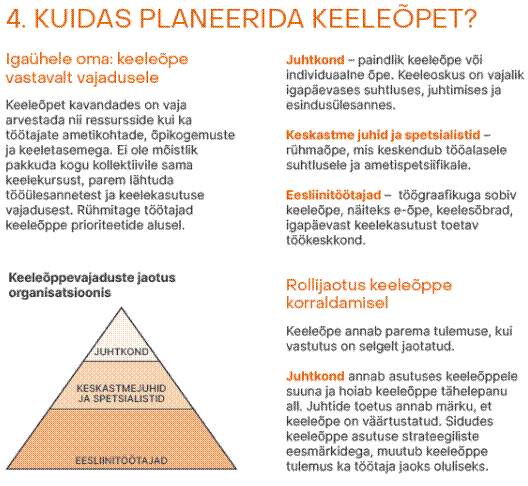
RS: The employer must first determine the current level of language proficiency within the organisation. Not what they assume it to be, but the actual level. Next, a plan must be developed on how to ensure Estonian-language communication in the workplace: where to begin and what goals to aim for. Naturally, resources must be planned according to target groups, and the sustainability of the activities must be taken into account. In the accompanying image, the top of the pyramid represents senior management, who must have a very high level of language proficiency, as they communicate both within the organisation and in representative roles.
The middle section includes middle managers, specialists, and others who must be able to read and write professional texts and who communicate daily with their teams and cooperation partners. Cooperation, innovation, etc. depend on them. At the base of the pyramid, there are employees who frequently interact with clients, as well as those who need passive language skills in order to understand work tasks, ask questions, and comprehend the answers.
KM: How to teach Estonian to employees and managers?
RS: All employees can be offered e-learning solutions – mobile applications, independent exercises, videos, and similar tools. At the same time, language learning should definitely also take place in the workplace, encouraging language practice in a supportive and friendly environment. For example, Estonian-language word labels or table posters can be placed in break areas, a weekly language café can be organized, and language buddy partnerships can be initiated. Employees should be encouraged to speak Estonian in situations where, out of convenience, they might otherwise switch to another language.
In short, the base level of the pyramid, the largest group of employees, could primarily be offered flexible e-learning solutions, the middle level could benefit from a combination of different learning formats, and the top level could receive tailor-made one-to-one language training.
You should also keep in mind that the cost of language training should remain affordable for the organisation, so that the initiative would not have to be discontinued after a year because it becomes too expensive.
HM: How else can language learning be supported in the workplace? For example, a weekly Estonian Language Day could be organised, during which everyone makes an effort to speak only Estonian. Meetings could be held in Estonian, and language learners could be involved in preparing and organising joint events. Gradually integrate Estonian into the daily work routine – start with greetings in Estonian and meeting agendas in Estonian. Initiate Estonian-language conversations during breaks.
Language learning is not only a concern for employees
We sometimes fail to notice the efforts made by our colleague in learning the language, assuming that it is solely their responsibility to master it. However, when acquiring a new skill, support from colleagues is also essential. It is difficult to learn professional workplace language alone, helpful and supportive colleagues are needed. For example, the language proficiency of a caregiver working in a hospital is not just their personal concern or need, but a matter for the entire team in order to provide high-quality care to patients.
Shared responsibility for language learning can also be described by the English expression ‘share the burden’ – take some of the load onto your own shoulders from a colleague who, in addition to their work duties, is striving to learn the language. They could be supported through language practice, by speaking Estonian with them. Unfortunately, it is quite typical for Estonians to quickly switch to Russian or English when speaking with someone whose mother tongue is different. But if that happens, the person will never fully learn the language.
The employer must also explain to employees who already speak Estonian why everyone should make an effort when a colleague is learning the language. For example, they should take into account that speaking a second language is often hindered by fear and insecurity. When speaking in our native language, we usually feel smart, competent, and witty, but when speaking in a foreign language, we can feel constrained and sometimes even foolish. Speaking in a second language is already stressful for many, and if someone looks at it disapprovingly, it is certainly not easy to be in the shoes of the language learner. It should not be assumed that a language learner immediately understands rapid speech or technical language at 100 words per minute.
Language buddies support language learning
Word labels, table posters, language buddies, language cafés, mobile apps, and everyday work tasks in Estonian – all of this supports language learning. Opportunities for learning and practising the language must be introduced both to those who are learning and to those who are already proficient. Estonian-speaking colleagues play a very important role in the language learning of an employee. In several countries, workplaces implement language buddy programs, where at least once a week a language learner and a proficient speaker converse about work topics. The proficient speaker uses simpler language, speaks more slowly, and listens patiently. Language learning should not feel like a hopeless battle against windmills, progress should be made step by step. Even small improvements are enjoyable, there is no need to wait for a big leap to feel satisfied.
KM: What should be done if an employee does not speak Estonian at all? Can they manage in a language café or when interacting with a language buddy?
HM: Language cafés and conversational practice are generally suitable for those who already have some basic knowledge of Estonian. When starting to learn a language, most people benefit from a traditional language course. Alongside this, workplace language practice can also be provided. Many simple learning activities are suitable even for someone with zero language skills, for example, adding Estonian labels to objects.
KM: When and for how long should employees learn?
HM: Time is of the essence. Ideally, language learning should take place during working hours. Employees have their own lives, children, and pets. If someone had to attend a course in their free time and also complete homework exercises, it would be very difficult for them. Employers would benefit from asking how language learners would like or are able to learn the language at the workplace.
What motivates people to learn Estonian?
KM: In Estonia, finding or keeping a job is often linked to knowledge of the Estonian language. It is very important for us that people are able to manage on their own: on the one hand, so that employees have suitable positions, and on the other, so that we would have the necessary workers and specialists. Therefore, employees can be motivated by career opportunities or a good job. There are also discouraged individuals who have lived here for decades but struggle with Estonian. They often claim that language learning does not suit them, that they are not ‘language people’, or that they lack motivation.
HM: Motivation is certainly one of the biggest factors in language learning. Motivation can be related to obtaining or keeping a job, but it is not always work-related, other factors may also play a role. For example, in Estonian society, it is becoming increasingly important to support one’s children in their Estonian-language education.
The introductory webinar presenting the guide can be viewed in full here.
Guide ‘Support your employees’ language learning!’ The guide for public sector employers to improve the Estonian language skills of people from diverse linguistic and cultural backgrounds is available as a PDF on the website of the Integration Foundation: https://integratsioon.ee/toeta-tootaja-keeleopet
Preparation of the guide has been funded from state budget and with the support of the European Union’s Cohesion and Internal Security Policy Funds (ESF) for 2021–2027 within the framework of project No. 2021-2027.4.07.23-0005 under decree No. 80 of the Minister of Culture of 15 March 2023 ‘Conditions for granting support for the implementation of activities supporting integration, including adaptation, in Estonian society’.
Helena Metslang, Researcher in Language Learning Policy, University of Tartu
Katrin Maiste, Head of Labour Market Services at the Integration Foundation
Robert Szabo (Germany), Master of Educational Sciences, developer and academic lead of international language programmes


