
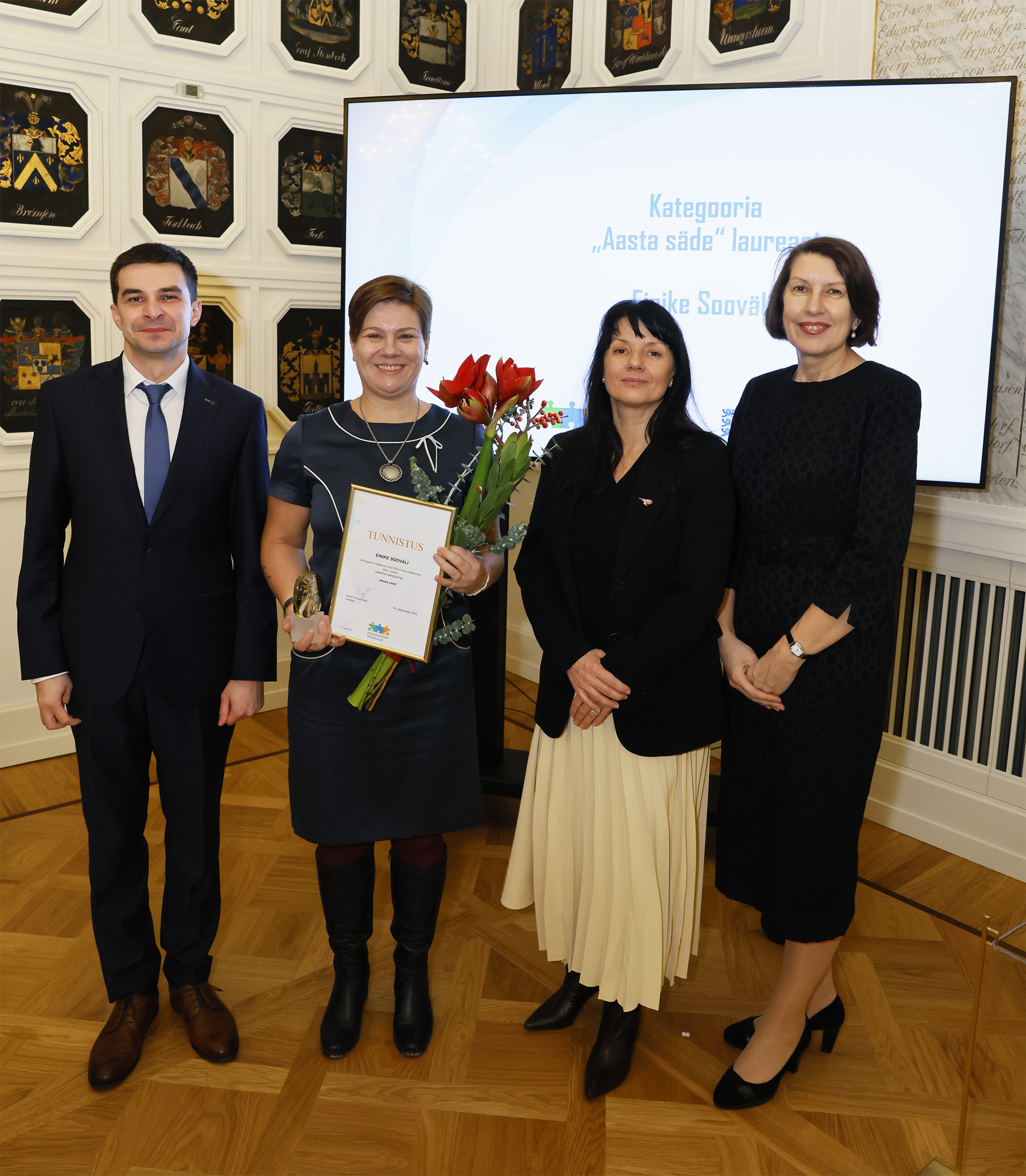
The winner of the 2025 Integration Awards in the category ‘Spark of the Year’ was Einike Sooväli, who has ignited the flame of integration in many people all over Estonia. In 2025, nearly a thousand people from all over Estonia took part in the integration programmes of the Estonian Open Air Museum led by Einike. However, the broader impact of her activities can be measured in the thousands. Einike Sooväli is a committed promoter of integration, whose work combines empathy, creativity, and a sincere belief in the values of cultural diversity. The language and culture club Keelekompott (Language Compote) has grown under her leadership, and integration activities have expanded to schools, museums, and even prisons. Her work is characterised by passion and a belief that change can be brought to society by teaching people to love cultural diversity and value everyone.
Read more about her activities in this interview.
At what point did you become a person who wants to promote intercultural understanding?
The desire to engage in integration came from personal experience. At the age of 20, I went to Saint Petersburg to study, not knowing any Russian. I was very interested in Russian literature and loved the atmosphere and architecture of Saint Petersburg. When I arrived there, I realised how difficult it is to understand what is going on around you when you do not understand the language – it felt like both my tongue and hands were tied. Everything had to be communicated in body language. Not being understood was not even the hardest thing; to me, not understanding what was going on around me was worse. It was as if a bag had been put over my head.
I quickly realised that in order to feel at ease and to understand the people around me, I needed to learn the language. This led to a desire to help others in Estonia to adapt and understand each other better.
What or who has most influenced the way you do your job?
I have always been interested in different cultures and peoples. The journey of learning and acquiring the language in Saint Petersburg had the biggest impact on me – I saw for myself how language skills can open up a whole new dimension. In my second year, when I could clearly communicate in Russian, I had a huge sense of freedom and security, knowing that I could handle any situation. This knowledge has always stuck with me in my work.
What is it like to bring the Estonian language and culture to so many different places: schools, museums, communities, and even prisons?
I am drawn to constant change and cannot stand routine, so I am very happy to be able to take Estonian to very different places. In a museum, language learning is supported by everything around us, but in schools, you need tangible results because students have exams coming up. In prisons, we talked to people there about food culture and prepared dishes, and in the process, they learned new words and gained knowledge about Estonian culture.
Working in these environments demonstrates the many ways in which language can be learned and taught.
Can you think of a particular encounter or story that confirmed how important this work is?
The best moments are when I see real changes in people. One participant in the culture club got the job they had long wanted, thanks to their improved Estonian. It is also touching to see how people become more and more fluent in the language they use in the club and are happy to be understood. Being able to see their progress is what makes the teaching process so rewarding.
How was Keelekompott born and why did it seem necessary?
The project was born out of an idea by the Integration Foundation to offer the opportunity to learn Estonian language and culture at museums for free. A lot of foreigners are tired of being told that they have to know Estonian and learn it because it is so difficult. We focus on the fact that Estonian can be interesting and even funny. I shared my experience of how I learned a second language, and in the club, we do all sorts of fun things where language skills come naturally.
What changes or improvements do you see in the people who participate in your programmes?
I see people grow more confident and start to believe in themselves. They start to communicate more fluently in Estonian, see that they are understood, and become more motivated. For some, language skills open the door to a dream job, for others, to new friendships. Practical contact with culture gives language learning a deeper meaning.
What does integration mean for you?
For me, integration means that people from different cultures feel comfortable and safe together in Estonia. It is about understanding each other and accepting our differences. Language and culture learning is a tool to help achieve good integration.
What changes in the local multicultural society make you hopeful?
What makes me hopeful is that there are many good alternative ways to learn languages and that interest in them is growing. Switching to Estonian-language education will help to make society more cohesive: young people of different nationalities will interact more and develop strong friendships. It is also encouraging to see that people from increasingly diverse backgrounds are coming to Estonia and that more attention is being paid to involving volunteers in the field of integration.
What has been the most touching moment in your work?
The most touching moments are when I see a person overcome their fears or limitations – whether it is having a first conversation in Estonian, finding a job, or discovering that they are understood. These small victories are often bigger than they seem on the surface.
Have there been difficult times? What keeps you motivated?
The most difficult thing is to teach people with very different language levels at the same time. It is difficult to find a pace that suits everyone. Sadly, some of the newly arrived immigrant students are not motivated to learn Estonian – it is difficult to explain to children why learning the official language is important.
I remain motivated because I know how much one person can influence the future of another. Seeing the learners succeed also helps.
What new ideas or programmes would you like to see implemented in the future?
I would like to take part in language camps – for example, tandem camps, where people from different cultural backgrounds live and work together for several days. Past experience has shown how quickly people converge in such an environment. I also dream of the opportunity to learn about integration processes and success stories in other countries.
What do you dream of when you think about the future of cultural diversity in Estonia?
I believe that the future of a multicultural society in Estonia is bright. More and more activities are being offered to support language and cultural learning, and people are more open to each other. The more integrators there are, the more integrated people there will be, and the more cohesive Estonia will become.