
The winner of the 2025 Integration Awards in the category ‘Building Blocks of Integration’ is Natalia Ermakov, Senior Research Fellow at the Estonian Literary Museum and Head of the Estonian Union of National Minorities. She is committed to unifying the nationalities living in Estonia and promoting intercultural understanding. She organises the Estonian Nationalities Forum and the Etnolaat Fair, which bring together communities of different nationalities. She has created opportunities for the integration of ethnic minorities and increased the visibility of heritage culture. Her research and community work helps to preserve and value the cultural diversity of Estonia. She is dedicated to creating synergies between linguistic and cultural communities and researchers and artists. Her work is living proof that cultural diversity is our common wealth.
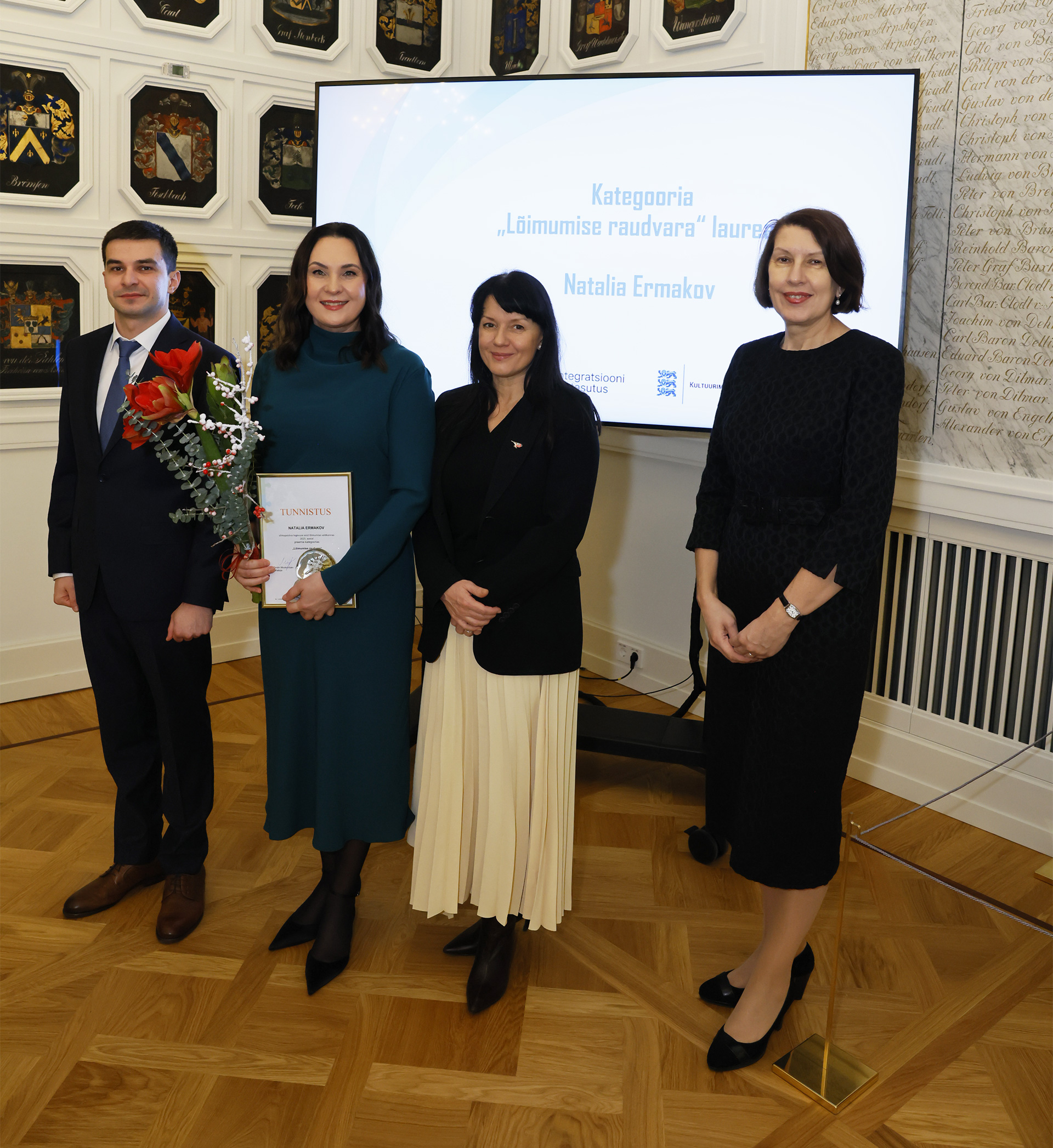
In this interview, Natalia Ermakov talks about her journey, values, and dreams that shape her work as a guardian of the cultural diversity of Estonia.
How did you come to the realisation that you wanted to contribute to preserving the cultural diversity of Estonia and promoting understanding between nations?
Having studied, worked, and interacted with people from very different cultural backgrounds, I became increasingly aware of how much richness and, at the same time, incomprehension coexist in our society. I was never a spectator in this process. From my first day in Estonia, I was involved in the Finno-Ugric movement through the Estonian-Mordovian Society and the Ersa Culture Association Sjatko, and directly in the activities of the Estonian Union of National Minorities as a whole, as the Mordovian Society is a member of the Estonian Union of National Minorities. The work of the Fenno-Ugria Foundation has also helped a lot. My inner need to contribute to the promotion of inter-ethnic understanding was a natural part of my learning and working process. I have been thinking more deeply about it since I started a family and had children. I asked myself what I could do to ensure that my children, myself, and my fellow human beings can happily live and coexist in Estonia.
Can you remember a moment or an experience that confirmed that this is the right path for you?
Yes, there have been many such realisations. They come from the people around me and my family, as well as when I cooperate with different nations in Estonia and around the world. After I defended my doctoral thesis at Tallinn University, the research world also opened up to me at the Institute of the Estonian Language, the University of Helsinki, and now as a senior researcher at the Estonian Literary Museum. I am grateful that I can apply my knowledge in the fields of culture and science here. This is the path I want to follow.
What is the most important principle for you on which you base your interethnic cooperation?
The most important principle is mutual respect and appreciation, and a strong desire to do something good that inspires future cooperation and development. It means a willingness to listen, not to judge, to accept others, and to always find time for this mission. My colleagues are a great example and support for me!
The Estonian Nationalities Forum and the Etnolaat Fair have become traditions. What is the most important value of these events that is perhaps not noticed by the wider public?
The Estonian Union of National Minorities continues the work of the First Estonian Nationalities Forum, which was convened on 24 September 1988 and supported the restoration of Estonian independence. Its main objective has remained the same – to represent national minorities at the state and local government level, to raise awareness of national cultural identity, and to develop cooperation between Estonians and other nationalities living in Estonia. The Forum is a unique representative body in Estonia, dedicated to a different relevant topic each year. The Forum adopts declarations and makes statements reflecting the situation of national minorities in Estonia. The most important value is that our people contribute tremendously to Estonian society, despite the many difficulties that arise.
Etnolaat Fair is part of the Estonian Nationalities Forum, where participants can see our cultural diversity. It is a two-day event featuring national crafts and cuisine, as well as a concert programme by national collectives.
How do you define the word ‘integration’ – is it a conscious activity or a natural growing together of cultures?
For me, integration is a combination of both. It needs deliberate actions and a supportive framework, but it cannot be forced into existence. Integration is strongest when an environment is created where cultures can grow together naturally through mutual interest and voluntary participation.
What changes have you noticed in Estonian society over the years? What gives you hope?
I have noticed an increased openness and interest in different cultures. It is also positive that minority issues are increasingly part of public debate. It is encouraging to know that our younger generation is involved and that dialogue has become a necessary part of societal development.
Which moment or project has been closest to your heart?
The projects I feel most passionately about are those where I see a direct impact on people – for example, when someone says they have felt really included in Estonia because of something they have done together with the locals, or when people are grateful or have learned something exciting. These moments give a deeper meaning to all the work I do.
What are the next steps or ideas towards which you would like to see interethnic cooperation in Estonia develop?
We would like to celebrate the Day of Nationalities on 24 September as a flag day. This would encourage Estonians to notice, appreciate, and preserve the national culture of their own and their compatriots – our common cultural wealth. It would also increase mutual understanding and strengthen our unity, making Estonia a more cohesive home for us all. All communities and each of us deserve a day that brings us together in a common commitment to Estonia.
What do you dream of when you think about the future of the visibility and inclusion of ethnic minorities in Estonia?
My dream is to achieve a society where the visibility and inclusion of ethnic minorities is not a separate issue, but a natural part of the functioning of society, so that Estonia becomes a role model for other countries. I want everyone, regardless of their ethnic background, to feel that they have a good life here and to care about our common future.